Network effects (NE) is a phenomenon whereby a product or service gains additional value as more people use it. It is what goes on behind the scenes (like an invisible hand, or wind) that make businesses like Google, AirBnB, eBay and Facebook such defensible businesses.
NE is 1 of 4 defensibilities that a business can build It’s about adding value to users, making the business more defensible (or a moat). At a point where there is critical mass, it can offer increasing returns to scale. Other more traditional defensibilities are Scale, Embedding and Brand, and these usually taper at some point, with decreasing returns to scale.
NE is not the same as Viral effects, which is about user acquisition and growth. This is about retention and adding value to users and it provides a leverage to growth and defensibility.
NfX has defines 15 different types of NE and it’s worth considering how to add this into the designing of your business.
For those that are interested to learn more (1) Great articles – NFX has provided an excellent resource of their thoughts/ learnings at www.nfx.com. Another great resource is https://platformchronicles.substack.com/.
(2) An upcoming course – those that are looking for a course to attend to discuss and go more in-depth on these concepts could explore the “Building and Investing in Network Effects” by Andrei Hagiu and Julian Wright. They are having a 2nd run in February with the sign up here. I attended the 1st run in late 2021 and it was very insightful, I highly recommended it.
In the previous months, and especially so during the confined days of Singapore’s circuit breaker (or lockdown), food delivery platforms such as GrabFood, Food Panda and Deliveroo quickly rose from a convenience service to one of necessity, as the government restricted the movements and gathering of people with exceptions of certain necessary activities. The control measures has eased somewhat, but as I still observe significantly more food delivery scooters/ bikes/ motorbikes on the roads (compared to pre-covid), I think it is worth looking further into how this business has changed within this season.
1. Food delivery’s rising in importance and how does it fit in Grab?
Just in Dec’19, Grab’s food delivery and financial services generated more than 50% of gross merchandise volume (GMV), or sales transacted, across its platform. With the coronavirus impact and the sudden shift in consumer behaviors – more time at home (instead of traveling to work) and more convenience sought (and less movements outdoors) – this led to ride hailing reducing to a minimum level and food deliveries and e-commerce deliveries increasing by a correspondingly large amount.
The net effect was GrabFood become a very important part of Grab in the course of a few months – even more so than the original core business ride hailing. Grab was able to use their platform to somewhat meet the demand by adapting their service from moving people (ride hailing) to moving food (food deliveries) and goods (e-commerce deliveries). Imagine what it would have been if food deliveries weren’t established as a category at this point!
What Grab did was no small feat which I think highlights their ability to adapt and pivot, which would be increasingly important in the days ahead. According to CEO Anthony Tan (paraphrased), “the switch involved moving 149,000 drivers in a period of over two months from what they were used to — sending people to from place to place every day — to delivering food and shopping for 50 cities across 8 countries.“
There is a permanent (and accelerated) shift to digital– but who would be able to capture that value? NYU Professor Scott Galloway aptly termed the coronavirus an accelerant, as compared to the change agent itself, but went into detail as to how the Big 4 Tech Companies (Amazon, Apple, Google and Facebook) are “gaining more and more momentum and strength”, impacting various industries such as e-commerce, healthcare, education and media. In this particular case for Grab, CEO Anthony Tan commented in an interview with Fortune that he too saw a permanent shift in the use of e-commerce and e-payments, as their new users started to include older demographics (aged 35-55 and across the population). But for businesses like Grab and Uber where the core business of ride-hailing is severely challenged by travel restrictions, it might be a challenging period ahead for them to still be as ubiquitous and grow and increase in usage and influence.
2. Understanding Grab as a platform, or “super-app”. And the future of venture-backed companies in this new operating environment
Grab has started to established itself as a superapp and was making good traction just prior to the covid outbreak. It had built itself into one of the top consumer internet companies in Southeast Asia with various services such as food delivery, payments, health care, and financial services alongside ride hailing with rides in Southeast Asia, serving more than 187 million users in over 300 cities regionally.
Just prior to the coronavirus causing business and societal disruptions, what occupied news headlines in 2018 and 2019 in Tech regionally was the discussion on Grab vs. Gojek. This started since Uber’s retreat from SEA in Mar’18 and across the periods of massive fundraising rounds in the past 2 years where public comparisons of business traction was made for Grab and Gojek had raised $5.2Bn and $1.6Bn respectively to expand its products and grow regionally as a digital platform.
To succeed in this new operating environment, there needs to be further change in the approach, no longer one of aggressive growth typical of a venture-backed startup to be one that balances both the growth agenda and figuring out a clearer path to profitability and sustainability. This at the moment seems to include, exploring merging with Gojek to effectively corner the Indonesian market, and some headcount reductions (360 staff or 5% of total headcount) probably more as a signal to the organisation of the likely tougher times ahead and bidding for a digital banking license, currently a 60-40 JV with Singtel.
3. How are the fees split for GrabFood amongst its stakeholders? And can it provide a sustainable job for its riders? There has been a big debate on the delivery fees split amongst its different stakeholders – consumers (or users), merchants (F&B owners), rider-partners and Grab. The fundamental question is whether this is a fair fee to the merchants, and whether the delivery fees add up to a fair salary for riders. You could be able to read up more on this on The Straits Times (“Food delivery fees in spotlight“), Mothership (“Grab allegedly pocketed 50% of the cost of a food order made over GrabFood. What happened here?“) and on Grab’s own blog response (“#AskGrab: Where does the merchant commission go?“), but in the meantime I would provide a snapshot below.
The fees charged by Grab to merchants seems to be on average 25-30% of the order value, and at times up to 50%, this is separate from a delivery fee that is charged (that is distance dependent). I guess this is where the issues are – the merchant is already challenged by the high rentals, and no longer has the previous customer volume and spending, without taking into addition to additional costs in the current covid period. So what happened was probably a boost in business orders but at a loss situation. Merchants have petitioned to reduce this markup fee to closer to 15% (which has not happened), but Grab has responded by highlighting that the markup fee is in effect fair as it is at present given to riders as incentives to supplement the take home income.
4. Growth in the rider base network during the current times
During the months of the circuit breaker, there has been no problems with the food delivery platforms expanding their pool of talent, with Deliveroo reporting an 80% increase in rider applicants in April compared to March, and an increase in rider pool by 1000 to 7000. This is probably a reflection of the current difficult business environment and job market, adding on to good consumer branding and flexibility that these companies had built previously.
While this is good for many in the interim in between jobs, for those who have further aspirations for progression, such jobs inevitably does take a lot of time and energy, and is not straightforward in allowing one to effectively develop a good career pathway and progress in terms of skills to better differentiate and earn a better salary as the years build on. This is worth further thinking from the government and Tech companies as they build a sizeable workforce under this tag of a partner/ freelancer, and in any case for further thinking and planning for those who are working in such jobs.
5. Summarising – What have we learnt? What can we expect from here?
Food delivery is growing and very important in this age of increasing need for convenience and also safety (less societal exposure). One can make a living from this at a decent salary for hard work, but one has to think longer term if it would make sense.
In the meantime it would be challenging times for Grab looking ahead as they try to strike that balance both the growth and survival/ sustainability agendas. We can probably expect interesting product innovations to continue to happen in GrabFood and other platforms, designed to bring value to its various key stakeholders and the deepen users engagement/ stickiness in using the platform.
Some of those I have noted or ideated are as followed:
(1) Central kitchens (or virtual/ shared kitchens) – which are shared and centralised kitchens for eateries, specially designed for cooking and pickups, and to minimise wait times for delivery riders. These have been so far implemented by all 3 food delivery players (Deliveroo (3), Food Panda (1) and Grab (1) and also independents such as Smart City Kitchens (which is apparently linked to former Uber CEO Travis Kalanick). This might be interesting as they are natively designed for such delivery platforms and could be very efficiently plugged into them
(2) Onboarding of even more F&B outlets – these include the various restaurants, cafes, food kiosks in the shopping malls, and even hawker stalls. Hawker stalls in particular would be interesting as it can increase the number of food options and locations significantly. Grab has kickstarted this in May’20 and called this ‘“Hawker Centre 2.0” pilot initiative‘, allowing users to choose from a variety of stores located in the same area, for the same delivery fee – a play on both convenience and value (to users) and business at lower costs (to stall owners).
(3) Launching GrabProtect – Grab took the opportunity to launch this partnership with Unilever, tapping on their products and and touch points to enhance their brand image, and enhance the safety of Grab drivers and riders plus connect more small businesses onto the platform.
(4) Bringing on the older, less tech-savvy users – in the ideal world, we would be able to address “the long tail”, which in this case be the older demographics within our society. It would be an important achievement if they could be educated to be more tech-savvy and be able to order both food and also groceries online, especially if there should be cases of further lock-down measures in the future when borders open up again.
(5) Other ideas that increase value and deepen engagement + usage from existing users such as (i) “gifting” – where you are able to buy another person a treat quite easily, and maybe provide a nice printout or message across from one user to the next, or (ii) catering to meals for virtual work team meetings or training (distributed one order to many recipients). I haven’t seen these being implemented, but I think there should be sufficient demand for such in this covid period, given there would likely be restrictions to large group gatherings for the foreseeable future (till covid control measure ceases).
There’s been quite some coverage in the recent month about TikTok on a potential ban and also a M&A transaction that might shift its ownership from ByteDance (seen as Chinese) to Microsoft (USA) within record time. This news is rather interesting for me given my previous experience looking at M&A for digital media.
I would be using this post to discuss the matter centred around a few key questions. Hopefully this would shed some light on why this is matter is interesting from various perspectives:
What is TikTok?
What’s so special about TikTok?
Why the fuss?
Could this be a really good deal for Microsoft? Or whoever the buyer might be?
What could we expect in the coming days?
What is TikTok?
TikTok has been given the label of “Instagram for the mobile video age” by TechCrunch as is inherently a short form video app and social media platform that has gone viral in the recent two years.
ByteDance (their parent company) as a whole is drawing 1.5 Billion monthly active users to its family of apps (Douyin – Tik Tok’s Chinese twin, and Chinese news service aggregator Toutiao, and several others). Its investors include Softbank, KKR, General Atlantic and Sequoia China.
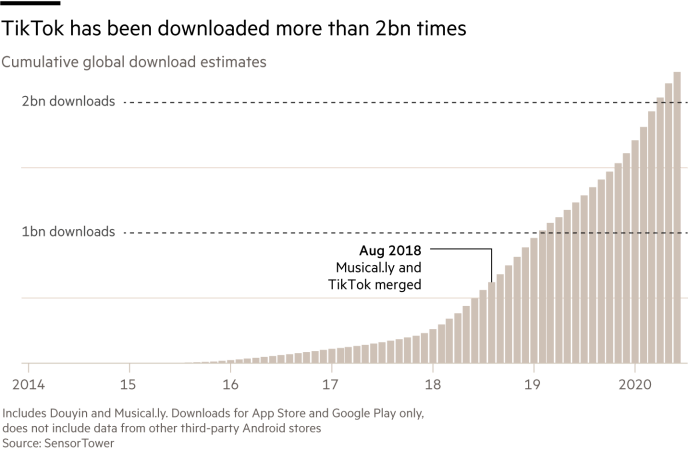
As we can see from the chart below, the covid-19 pandemic and subsequent lockdowns has actually accelerated the growth of TikTok – with downloads pushing past 2Bn in May’20 and 315Mn new downloads worldwide in Q120 according to Sensor Tower.
For more information on TikTok/ ByteDance, CB Insights offers a nice compact view through a free report over at their website.
What’s so special about TikTok?
Chinese technology company going global | TikTok has been the most successful Chinese-origin social media company globally so far, with talks that it can potentially displaced Facebook as the leading social network
Talent acquisition | They executed a major talent coup, hiring away Disney’s Head of Streaming, Kevin Mayer, as CEO of Tik Tok and COO of ByteDance. They are also still still in the midst of hiring even amidst the pandemic, with earlier plans of hitting 40,000 jobs in 2020 (+10,000 new jobs), which would bring them close to Alibaba’s
Valuation | They have been the most valuable private startup since Oct’18, valued at $75Bn vs Uber’s $72Bn. ByteDance has been recently (through secondary transactions in May’20) valued at between $105Bn to $140Bn (Bloomberg), with TikTok valued at about $50Bn (Reuters). To put this in perspective, this is more than Twitter ($30Bn), Snap ($32B) but still behind Facebook ($744Bn)
Built differently from other social networks| TikTok’s user experience is primarily driven by algorithms (curation and incentives) that enhances discovery, instead of the existing social networks or people that they might choose to follow. This leads to personalised content based on last watched videos, and recommendation to create content through its mix of viral hastags, challenges and memes. All these lead up to a sticky and addictive user experience and strong engagement metrics compared to other social media platforms (CB Insights)
Future monetisation potential (of ByteDance as a whole) | This are still seen as early in executing their monetisation strategy in the form of advertising and in-app purchases and with further potential in music, gaming and e-commerce (through live streaming). There is good reason to believe they would be able to succeed given the advantages they could capitalise on, such as (i) their young and engaged user base, (ii) success in developing and managing their products (for viral), and their (iii) personalisation and recommendation algorithms (CB Insights)
Why the fuss?
Trump’s intervention has brought various concerns to the surface about user data privacy and security concerns if the data can be access and used by the Chinese government. He has since issued executive orders that could potentially ban TikTok from operating in the US within the next few months, pushing for a potential sale and change of ownership to a US buyer.
This has follows what had happened in end-June, the Indian government had banned TikTok as part of a blacklist of 59 Chinese mobile apps they had deemed a threat to national security. Up to then, India had been its biggest market with >650Mn downloads according to Sensor Tower.
Could this be a really good deal for Microsoft? Or whoever the buyer might be?
Currently Microsoft seems to be the most viable acquirer, given
its current size and strong financial position, which would allow it to make this acquisition on its own
the potential to get into a consumer-centric social media business (asides from LinkedIn) for younger users, which could plug into its other ecosystems such as XBox gaming into
However that being said it would likely not be a straightforward acquisition as it might pull Microsoft right into the complexity of these political tensions. Bill Gates called for caution regarding this deal, calling it “a poison[ed] chalice“, which pretty much sums up his view. Microsoft would also have to immediately step up as a big player in the social media business and to content with content moderation and also gain enough assurances that the Chinese government would not embark on retaliatory measures post transaction.
Other potential options could be Twitter, but it does not have sufficient funding on its own. And a buyout led by current investors General Atlantic and Sequoia, with ByteDance holding a minority stake. But it is not clear if such an arrangement would be deemed acceptable by the US Treasury and the Committee of Foreign Investment in the US (CFIUS).
While all this is going on, other competitors are moving ahead to take TikTok on head on in terms of operational strategies, particularly in poaching of key content creators through various forms of compensation. This includes Facebook for Instagram Reels and Triller (a smaller competitor). TikTok has responded quickly by announcing a $200Mn creator fund to supplement the earnings of their US creators.
The ultimate value depends on the “deal package”| The deal would need to comprise of the technology, data and user base in order to preserve the user experience – keep the engaged base of users and communities – and hence value of TikTok. This would mean ByteDance would have to part with the algorithms and machine learning models, along with the historical usage data and pool of content in order to ensure a successful transition to the new buyer. Without this in place, TikTok would likely quickly lose its value after being sold (should it happen).
What could we expect in the coming days?
In the next 90 days (up to mid-November) we would likely hear more about how this potential deal develops, with information on viable suitors and deal structures coming to the forefront and also the rules of the game shifting, according to how Trump and the US government determines. And as many twists and turns that might come with the various parties and agendas along with the time urgency.
In return, we could also see retaliation from the Chinese government on US technology companies operating in China. We might see specifically happening with Microsoft should they eventually go ahead to acquire the company. But this might depend on whether ByteDance is seen with sufficient strategic importance (similar to Huawei).
I’ll look to do another check-in on this topic at the right moment in the coming weeks. Hope this has been an interesting read!
Netflix has been one of the companies within the “digital native” category that has benefitted positively from the current covid-19 period. Not just from the angle that many different forms of entertainment such as live events, gatherings and even cinemas are all closed due to potential spread of the virus, but also because they have utilised digital channels very positively to draw in both existing customers and new ones to their programmes.
Netflix is already well known in the industry and the top go-to paid entertainment channel for movies and drama, but they have been really clever in using alternative channels (not of their own) like Youtube and Facebook/ Instagram that are more far reaching to promote new content they are continuing to build and release.
So we might ask, just how many users are there across these various platforms?
So let’s take an example of a recent popular Korean drama that concluded in the 1st half of 2020, “Crash Landing on You”. The Swoon (Netflix’s channel on Youtube for K-drama and Asian drama) promoted it through trailers, memorable scenes and behind the scene footage. And it got many people talking and sharing these content, and looking forward to watching each episode as they were released. Given how many more users there are on the wider social network platforms such as Facebook and Youtube, such a strategy would have led to growth in subscribers and communities being built and engaged around the content.
Trailer for “Crash Landing on You” on Youtube’s “The Swoon” channel
Whats the overall effect of effectively using digital channels/ social networks?
(1) What we observe is in Singapore at least on the day-to-day is that many have started K-drama and continue to move from one to another, and these are common leisure topics amongst each other (even more so than the local television programmes)
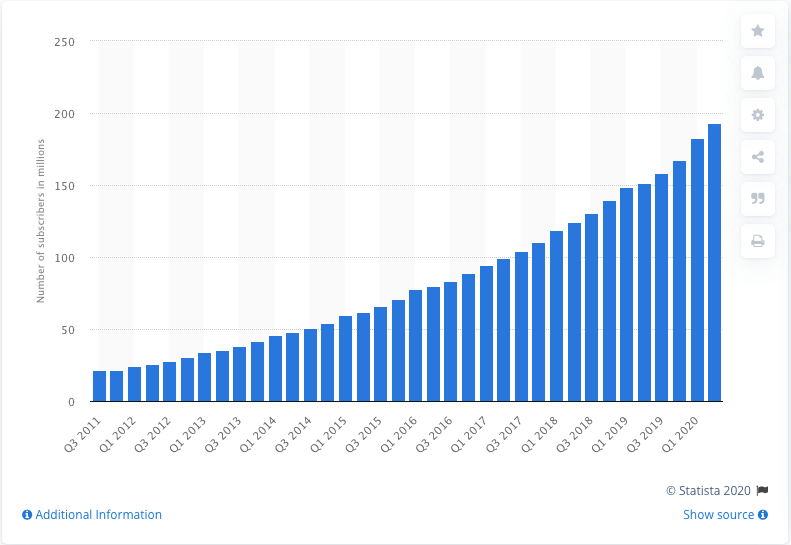
(2) Netflix continues to reach out effectively to new users and subscribers (growth in subscribers) and effectively build followers communities around their content. You can see how this has moved from the chart below from <25Mn in 2011 to the close to 200Mn subscribers today, an almost 10X in the 10 years. This would likely not have been possible if they had relied on traditional word of mouth to grow.
I think such ability to grow at this pace is really uniquely possible in today’s digital era, so it is something to keep in mind.-
Are there any methods or experiments that your company could undertake to leverage on potential opportunities to unlock and accelerate such “10X” growth opportunities?
The current times are definitely classified into such periods of uncertainty, starting with the discovery of the coronavirus (or covid-19) in Wuhan, China, and it starting to spread to various countries, each country having a different initial reaction but with the past 4 months, but all facing challenges similarly since the WHO named the coronavirus a pandemic.
The virus has impacted Singapore greatly as well (where I live). We have had interesting naming conventions locally, such as “circuit breaker” in place of lockdown. What has been fundamentally challenging is Singapore is a city state and has depended greatly on trading with the world in making our living, and in the much of recent memory has positioned itself to be a headquarters for the region for global companies. With today’s shutdown of borders for the past months, it has been a big challenge to resume business as usual for many.
But the coronavirus has not impacted all industries and companies equally. A very popular saying today is that the covid is probably the most effective digital transformation officer/ chief information officer there was globally, pushing every company to go digital in very short timeframes, very much in view of survival. In the next few posts, I would be exploring and zooming into a few key sectors and industries that have been impacted in the past months.
Welcome to my homepage! Here’s where I intend to pen down some of my thoughts that I have on a variety of subjects, broadly themed as “business, technology and life” and perhaps resources that I have found personally useful.
This would probably evolve as we go along, but in the meantime enjoy and hope you would find this useful. Sometimes we don’t know where we get to when we start, so here goes!
“Blessed is the one who finds wisdom, and the one who gets understanding, for the gain from her is better than gain from silver and her profit better than gold. She is more precious than jewels, and nothing you desire can compare with her. Long life is in her right hand; in her left hand are riches and honor. Her ways are ways of pleasantness, and all her paths are peace. She is a tree of life to those who lay hold of her; those who hold her fast are called blessed.”





 Thoughts on Business, Technology and Life